Bringing trust to Cybernemo: The Notary component for ZTNA

In CyberNEMO, we’re building a Zero Trust Network Access (ZTNA) solution where every access decision is based on verifiable evidence. One of the core building blocks of this architecture is the Notary component, powered by our Transparent Notary Service (TNS).

What is the Transparent Notary Service (TNS)?

The TNS is essentially a digital notary for network evidence. Its job isn’t to decide whether a piece of evidence is good or bad, but to make sure that once evidence is registered, it stays immutable, timestamped, and cryptographically verifiable.

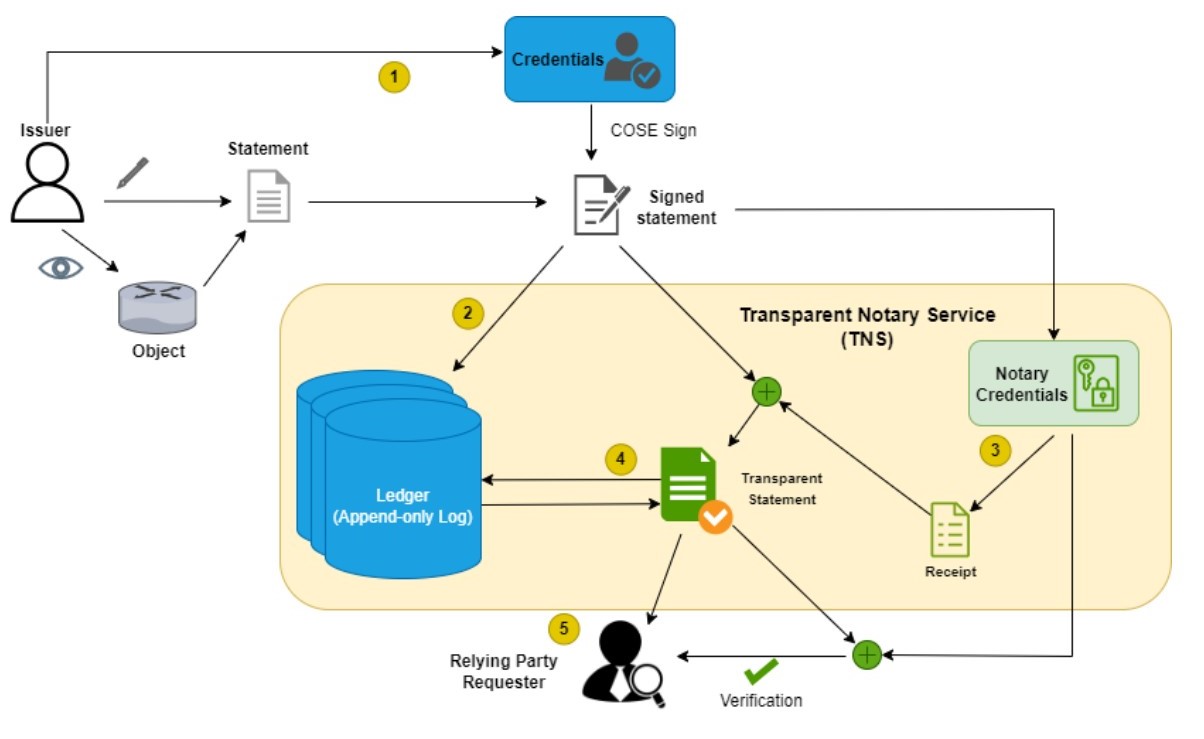
The TNS uses a lightweight append-only ledger. Each signed statement (such as a configuration attestation, event log, or policy proof) is stored in an immutable data structure like a Merkle tree. This allows anyone to verify inclusion and consistency without having to trust the notary itself.

How it works

  1. Issuers sign statements using IETF’s COSE (CBOR Object Signing and Encryption) with algorithms like ECDSA or EdDSA.
  2. The Notary logs the statement, storing it in the append-only ledger.
  3. A receipt is generated that acts as proof of inclusion
  4. A Transparent Statement is generated including the original statement along with its receipt
  5. Relying parties can verify the statement’s authenticity and timestamp independently using the TNS public key

This design ensures that if someone tries to tamper with evidence or hide a log entry, it becomes immediately detectable.

Why this matters for ZTNA

ZTNA is all about “never trust, always verify.” But verification needs to be trustworthy too. By introducing a tamper-evident, verifiable notary into CyberNEMO, we:

  • Create strong audit trails for security events.

  • Improve accountability and compliance by preserving evidence.

  • Allow independent verification of access decisions without centralizing trust.

In other words, the Notary helps make our Zero Trust architecture provably trustworthy.

Read More

Zero Trust Principles

Zero Trust Principles in CyberNEMO: Building security by Design


Zero Trust has become one of the most important paradigms in modern cybersecurity. At its core, Zero Trust means no implicit trust; everything must be verified, every time. Every user, device, application, and service must prove its legitimacy before gaining access to resources, regardless of whether it’s inside or outside the corporate network.


In CyberNEMO, we’ve embraced these principles as the foundation of our ZTNA (Zero Trust Network Access) solution. The goal is to reduce the attack surface, prevent lateral movement, and enforce consistent security controls across all environments.


Zero Trust Principles


In CyberNEMO, we use the following Zero Trust principles as our architectural baseline:

  • Identity verification and strong authentication to ensure that only legitimate users and devices gain access.

  • Least privilege access enforcement, granting the minimum level of permissions necessary to perform specific tasks.

  • Micro-segmentation of networks and services to prevent unauthorized movement within the system.

  • Continuous monitoring and risk assessment to adapt dynamically to evolving threats and anomalies.

  • Data-centric security to protect sensitive information wherever it resides or travels.

How CyberNEMO implements them


Cybernemo’s ZTNA solution was built with these ideas from day one:

  • Micro-Segmentation with L2S-M: Built on the NEMO-developed Link-Layer Secure connectivity for Microservice platforms, L2S-M provides secure, dynamic segmentation across multi-cluster environments, overcoming the limitations of conventional network segmentation solutions.

  • Advanced Metrics & Telemetry: Using the ALTO protocol, combined with insights from BGP-LS, SDN controllers, and inventory systems, CyberNEMO ZTNA exposes abstract, real-time network metrics. These insights enable orchestration and deployment decisions that are aware of current network conditions and can react adaptively.

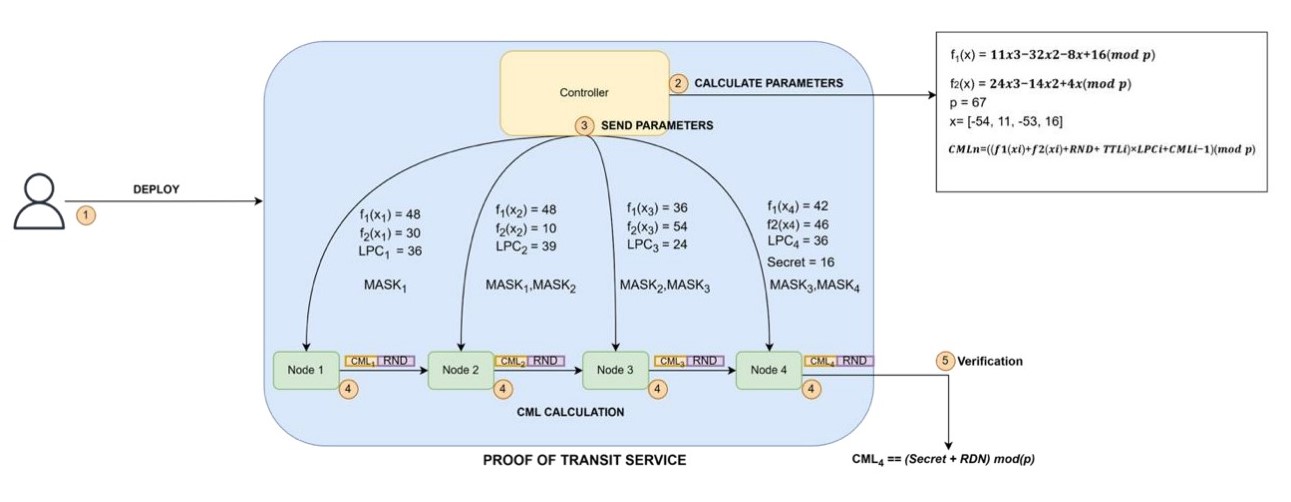
  • Secure and Verifiable Data Plane: Proof of Transit (PoT) is incorporated to validate packet flow integrity and sequence, providing traceability, regulatory compliance, and resilience against routing attacks or traffic manipulation.

  • Identity & Evidence Management: CyberNEMO adopts Distributed Ledger Technologies (DLTs) to ensure immutable, auditable records of access and configuration events.

    1) The Distributed Identity Manager (DID Manager) issues and validates decentralized, verifiable credentials, enabling federated identity management.

    2) The Transparent Notary Service (TNS) acts as a cryptographic notary for signed statements, preserving their integrity, timestamp, and origin authenticity. This allows any party to independently verify security events, configuration attestations, and policy decisions without having to trust the notary itself — enhancing accountability and auditability.

  • Policy Enforcement & Anomaly Detection: Network policies are enforced dynamically, while real-time anomaly detection mechanisms help mitigate threats as they emerge.

From Principles to Practice

Zero Trust is more than a security concept, it represents a fundamental shift in how networks are designed and operated. By embedding these principles directly into its architecture, CyberNEMO delivers a verifiable, adaptive, and resilient ZTNA solution for modern distributed environments.


With strong identity management, cryptographic evidence, micro-segmentation, and continuous monitoring, CyberNEMO provides not just access control but confidence in every access decision.


In short, CyberNEMO transforms Zero Trust from a guiding principle into a practical, measurable, and future-ready security architecture, enabling secure connectivity, prevent lateral movement, and build a trustworthy foundation for critical communications.

Read More

CyberNEMO: Enabling Zero Trust in the IoT-Edge-Cloud Continuum

The Company

Engineering is the Digital Transformation Company, leader in Italy and expanding its global footprint, with around 14,000 associates, with over 80 offices spread across Europe, the United States, and South America and global delivery. 

The Engineering Group, consisting of over 70 companies in 21 countries, has been supporting the continuous evolution of companies and organizations for more than 40 years, thanks to a deep understanding of business processes in all market segments, fully leveraging the opportunities offered by advanced digital technologies and proprietary solutions. 

With a strong and relentless focus on Innovation, through our R&I division that comprises over 450 researchers and data scientists (and a global innovation network of universities, startups, and research firms), the Group continues to invest in international R&D projects while exploring groundbreaking technologies and developing new business solutions.

This unique approach positions Engineering as a key player in the creation of digital ecosystems that bridge the gap between different markets, while developing composable solutions that ultimately foster a continuous Business transformation. 

The CyberNEMO project

After the Covid19 pandemic, remote working highlighted the limitations of traditional VPNs with respect to remote access security. It is necessary to protect users, regardless of the connection point, on the one hand by considering Zero Trust on remote devices, the access network and the edge cloud, and on the other hand by enabling transparent IoT-Edge-Cloud Computing Continuum.

CyberNEMO represents a paradigm shift towards Continuum IoT-Edge-Cloud Computing, which it sees as distributed European critical infrastructure. To achieve mass adoption, CyberNEMO leverages existing by-design and by-innovation cybersecure systems and zero-trust architectures, and introduces new concepts, methods, tools, test frameworks and engagement campaigns to go beyond the current state of the art and create sustainable innovation.

CyberNEMO implements Zero Trust Network Access (ZTNA) as a cybersecurity model that requires strict identity verification for any device or microservice trying to access the resources of a private network, regardless of whether it is inside or outside the network perimeter.

ENG is WP1 leader about end-to-end CC risks assessment & incidents, mitigation strategies. ENG also will contribute in WP2 to developing a solution to ensure Zero Trust Network Access (ZTNA) on 5G network and in WP3, ENG will develop an event correlator establishing a partnership with ATLANTIS project.

Read More

RWTH: Smart Automation and Cybersecurity for Energy Systems in CyberNEMO

The Institute for Automation of Complex Power Systems (ACS) at RWTH Aachen is one of the four institutes of the E.ON Energy Research Centers founded in 2006. The institute pursues a multidisciplinary research approach and addresses, among other things, questions regarding the monitoring of active electrical distribution networks as well as the appropriate automation architecture for distributed monitoring and control functions. ACS is unique in its composition of experts in the energy, as well as information and communication sectors. This interdisciplinary nature of the chair has led to various preliminary work on IT solutions for energy-related issues.

ACS has been leading research on standardized automation architectures for active electrical distribution networks in European projects as well as on data-driven monitoring structures. Thanks to the competencies in the areas of monitoring, energy systems, and control, the chair is researching solutions for distribution networks automation, state estimation and control, including agent-based solutions. Another focus is the interface between energy and information technology, in particular for data aggregation and analysis to obtain insight.

As part of CyberNEMO, ACS contributes expertise in the areas of high-performance computing, cybersecurity and artificial intelligence. ACS is actively involved in intrusion prevention, detection and mitigation solutions, whereby novel concepts in machine learning and knowledge representation are leveraged to protect critical infrastructures.

Read More

Universidad Carlos III de Madrid

The Universidad Carlos III de Madrid (UC3M) is a public and innovative Spanish leading university, which was recognized in 2009 as a Campus of International Excellence in Spain. Founded in 1989, it has more than 25,000 students and more than 2,000 teachers of recognized competence across diverse fields, including Humanities, Science, and Engineering. The university comprises 30 research-oriented departments, offering 38 Bachelor degrees and 152 postgraduate programs. UC3M is among the best universities in Spain and is included in the first quartile of the QS World University Rankings that highlights the best universities in the world.  

Within UC3M, the Network Technologies (NETTEC) group from the Department of Telematic Engineering is actively contributing its expertise to the CyberNEMO project. The research team involved in CyberNEMO excels particularly in connectivity orchestration for Edge/Cloud/NFV ecosystems, developing innovative models for highly dynamic NFV infrastructures, and ensuring quantum-protected communications within multi-domain cloud-native environments. Moreover, the group is a key member of 5TONIC, an NFV experimentation ecosystem comprising three Edge/Cloud/NFV domains, further reinforcing its practical and research-driven capabilities.

 Leveraging this robust foundation and deep technical expertise, UC3M plays a vital role in CyberNEMO as one of the principal technical implementers of the network component. Specifically, UC3M provides essential technical support for the development of the project’s Zero Trust Network Access (ZTNA) component and actively participates in the Smart Media Distribution use case.

Read More

TID in CyberNEMO

Telefónica Innovación Digital (TID) is a leading technology subsidiary of Telefónica, created through the merger of Telefónica I+D and Telefónica Digital in 2023. TID is dedicated to driving digital transformation by developing advanced technologies and innovative solutions across multiple domains, including artificial intelligence (AI), cybersecurity, transport network technologies, cloud computing, and big data. The company employs a highly qualified workforce, primarily composed of engineers and technology specialists, who are actively engaged in research, development, and the implementation of cutting-edge digital platforms.

TID actively promotes open innovation, collaborating with startups, universities, and research centers through initiatives and national and european projects. This collaborative approach accelerates the adoption of disruptive technologies and supports the development of sustainable, secure, and inclusive digital solutions.

TID, as a part of the Telefónica Group, is in charge of innovation and strategic vision of emerging network and security technologies, with its main goal centered on applying new ideas, concepts, and practices in addition to developing advanced products and services. TID plans to communicate and promote the CyberNEMO results, especially Zero Trust Network capacity results, within the Telefonica Group units working with our business units and Telefonica Tech (cybersecurity services). This will include internal proofs of concept, field trials, and training, with the goal of making these units incorporate the results of CyberNEMO into our commercial service offer beyond the end of the project.

Read More

CyberSocial Lab in CyberNEMO

CyberSocial Lab Srl Impresa Sociale (CSL) is a social enterprise committed to fostering secure and responsible innovation in disruptive technologies such as 6G, AI, and advanced security systems. CSL focuses on understanding the societal impact of these technologies by collaborating with key stakeholders. Core mission of CSL is to bridge the gap between technological advancements and societal needs, translating findings into actionable insights for businesses, policymakers, and civil society. CSL conducts research on the social implications of technology, transforms this knowledge into concrete guidelines and recommendations for responsible use, and provides education and training initiatives alongside socially-oriented cultural activities. CSL ultimately strives to ensure that technological progress aligns with the well-being and security of society.

In the context of the CyberNEMO project, CSL leads the ethics and regulatory governance (ERGO) framework, ensuring responsible innovation and compliance with EU values and rules. The ERGO framework enables the elicitation of ethics and regulatory requirements for the development of the technology and the implementation of pilots.

Moreover, CSL leads the implementation of the Privacy Protection Enforcement (PPE) technological solution, enabling data exchange in compliance with EU regulatory framework.

ERGO and the PPE are two relevant assets that will extend the CSL portfolio.

Indeed, ERGO framework is already an asset of CSL and it will be extended with the new regulations and requirements. CSL, and its sister company CyberEthics Lab. (CEL), use this framework for the providing consultancy services related to regulatory compliance.

Moreover, the PPE will allow to extend the ReD component (Regulatory-compliant data exchange), that is another asset of CSL. It is important to highlight that the ReD is the engine and the core of another asset of CSL, namely the SmaC component. SmaC has been recognised as a Key Innovation by the EC Radar Key Innovation Award (https://innovation-radar.ec.europa.eu/innovation/56307).

Read More

CyberNEMO Eclipse Research Labs

CyberNEMO open-source strategy is well integrated with the Eclipse Foundation framework for successful, vendor-neutral, business-friendly open-source. This framework (see Figure 1) is based on four main pillars: (i) infrastructure for open collaboration & development (ii) integration relevant open-source communities and business ecosystems (iii) governance for managing successful open-source projects and community building and (iv) intellectual property (IP) management that ensures IP is tracked and properly managed and open-source project results can be exploited by academic and commercial partners alike (v) improving the open source supply chain security. This framework is operationalised by the CyberNEMO open-source strategy. 

In order to achieve this vision and starting an open-source development practice, Eclipse provides an open-source repository called CyberNEMO Research Labs LINK

Read More

CyberNEMO in European CI security policy

CyberNEMO aims to generate tangible blueprints for CI and supply chain risksand contribute to the implementation of the EU Security Union Strategy and an interconnected cross-CI security roadmap. To achieve the goal, CyberNEMO will promote new work items in Standards Development Organisations (SDOs) relevant to cyber-physical security. CyberNEMO will significantly contribute to ECSO (European Cyber Security Organisation) activities, where ENG and TSG is active member and EOS (European Organization for Security), where ENG is founding members and members of the board of directors. Moreover, via PSCE (Public Safety Communication Europe Forum), CyberNEMO will share knowledge and expertise, leading to better protection of critical infrastructures against all types of threats and hazards. CyberNEMO partners INTRA will actively contribute to the ENISA coordinated Stakeholder Cybersecurity Certification Group (SCCG). CyberNEMO Standardization. TSG and UPM are co-chairing the security working group in 6G-AI where the main focus is on applying AI for cloud native applications and 6G applications in terms of automation, detection, or remediation. TSG has an active participation in the CNCF community and will work to share the main goals of the project in relation with cloud native communications, and cloud continuum.

Synelixis participates in the Alliance for AI, IoT and Edge Continuum Innovation (https://aioti.eu/)  and contributes to the convergence of AI, IoT and Edge Computing research and innovation, standardisation, and ecosystem building. 

DNV and CSL through their presence in the CEN-CENELC JC21 and ISO/IEC JTC1will be able to share their expertise and outcomes of the CyberNEMO project and therefore contribute to the working groups related to artificial intelligence and its trustworthiness.

CSL defines policy options regarding the ethics and regulatory challenges in the context of AI and cybersecurity and debates these options with policy makers and other relevant stakeholders.

UPM is participating in GAIA-X in order to develop a federated secure data infrastructure. It will be able to promote the results of the CyberNEMO project to the GAIA-X.

SYN, RWTH and INTRA are participating in the AIOTI alliance, where they will share knowledge about the deployment of IoT innovation in real scale experimentation.

Read More

Ransomware’s Rising Tide: Why Collaborative Defence is Key for SMEs

The Challenge


Ransomware, a sophisticated “digital protection racket,” is no longer just a nuisance; it’s a crippling threat, especially for Small and Medium-sized Enterprises (SMEs). These attacks, where cybercriminals encrypt data and demand payment, can halt operations, damage reputations, and even close businesses, as seen with an Italian SME that ethically refused to pay but faced temporary shutdown.
SMEs often lack the robust cybersecurity of larger firms, making them prime targets. But fighting back individually is tough.

A proposed solution

A united front. Experts argue for a collaborative defense strategy, centred around a shared and constantly evolving Body of Knowledge (BoK). This dynamic resource would pool insights on attack methods, threat actors, and effective defences, empowering everyone.
However, sharing sensitive Cyber Threat Intelligence (CTI) requires trust and compliance, especially with privacy and data protection (i.e., GDPR – Regulation EU 2016/679). This is where innovations like the ReD Service proposed by CyberSocial Lab. in CyberNEMO come in. Using smart contracts on a blockchain and robust pseudonymisation mechanisms, it enables secure, compliant CTI sharing based on explicit consent. This ensures personal data, as well as confidential and sensitive data, remains protected while fostering a collective shield.


Responsible Innovation


Recognised by the European Commission’s Innovation Radar and contributing to UN Sustainable Development Goal 16 (Peace, Justice and Strong Institutions), the ReD Service exemplifies a proactive, collaborative cybersecurity posture – essential for SMEs to navigate today’s complex threat landscape and build resilience.
An extended version of this blog is available at: https://cyberethicslab.com/en/government-data-sharing/

Read More