
CyberNEMO: Building a Responsible and Resilient Data Ecosystem for Europe’s Digital Future

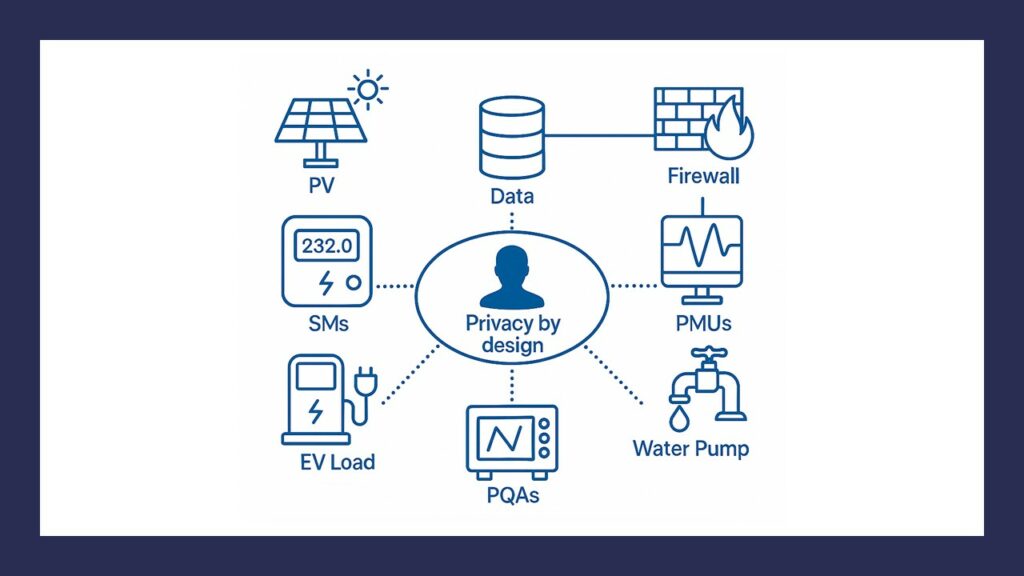
As Europe’s digital infrastructure grows more complex—linking IoT, Edge, Cloud, and AI technologies—ensuring the ethical, secure, and sustainable management of data has never been more critical. In the CyberNEMO project, this responsibility is not just a technical necessity—it’s a guiding principle.


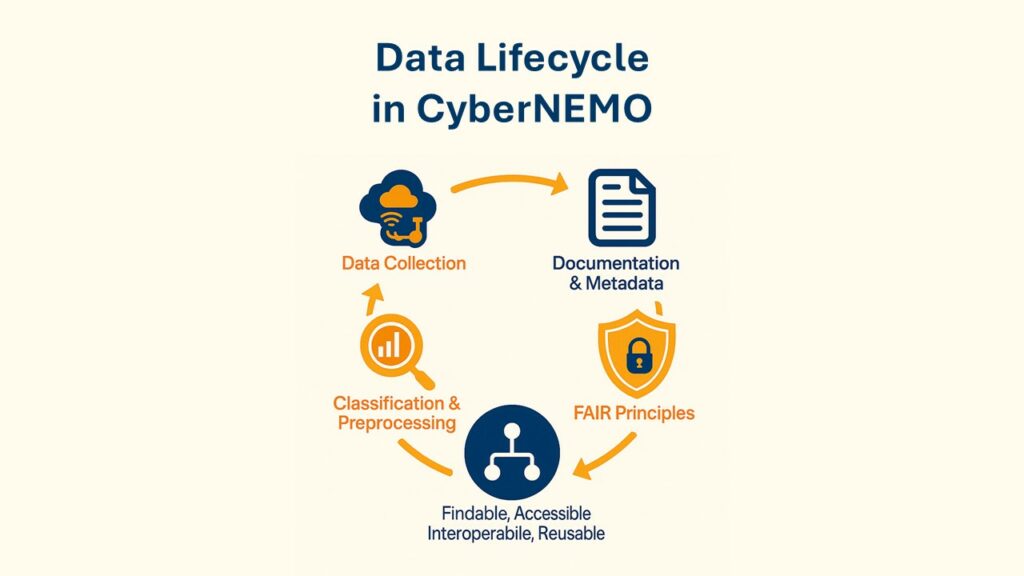
CyberNEMO adopts a robust, forward-looking Data Management Strategy designed to support innovation while fully respecting data privacy, cybersecurity, and FAIR principles (Findable, Accessible, Interoperable, Reusable). This approach enables the project to handle a wide range of data, from real-time IoT sensor streams to penetration testing logs and AI training datasets, while promoting transparency and reusability.


Key highlights of the strategy include:
• Use of trusted, secure repositories (e.g., EOSC, Zenodo) with persistent identifiers and standard metadata for traceability.
• Full alignment with GDPR and ethical AI frameworks, using anonymization, pseudonymization, and multi-layered security safeguards.
• Promotion of Open Science, including open access to peer-reviewed publications, AI/ML models, and experimental results.
• A structured and evolving data lifecycle that adapts to emerging risks, standards, and stakeholder feedback.

CyberNEMO not only ensures responsible data stewardship within the project but also creates a replicable model for European research and innovation. By combining technical excellence with ethical governance, CyberNEMO is helping shape a secure and trustworthy digital future.

By ASM

Read More

Cybernemo will be organizing a workshop in SecSoft25

We are glad to announce that CyberNEMO is organizing the SecSoft25 Workshop in collaboration with other cybersecurity-oriented European projects!

This event will take place in Budapest in June 2025.

The SecSoft25 Workshop aims to address the evolving challenges in cyber security as business models increasingly reshape ICT services and infrastructures. With the rise of softwarization, virtualization paradigms, and their integration with physical environments, traditional security measures are struggling to keep up with sophisticated cyber threats.

We invite researchers and practitioners to contribute their insights on a wide range of topics, including:

  • Cyber-security platforms and architectures for digital services

  • Security, trust, and privacy for industrial systems and IoT

  • Monitoring, advanced data collection, and analytics

  • Virtual and software-based cyber-security functions

  • Intelligent attack mitigation and remediation

  • Machine learning, big data, and network analytics

Join us in Budapest to explore innovative solutions for enhancing situational awareness and response capabilities against cyber threats. Collaboration will help to bridge the gap between technology evolution and cyber security.

Read More

Cybernemo 3rd General Meeting hosted in Madrid

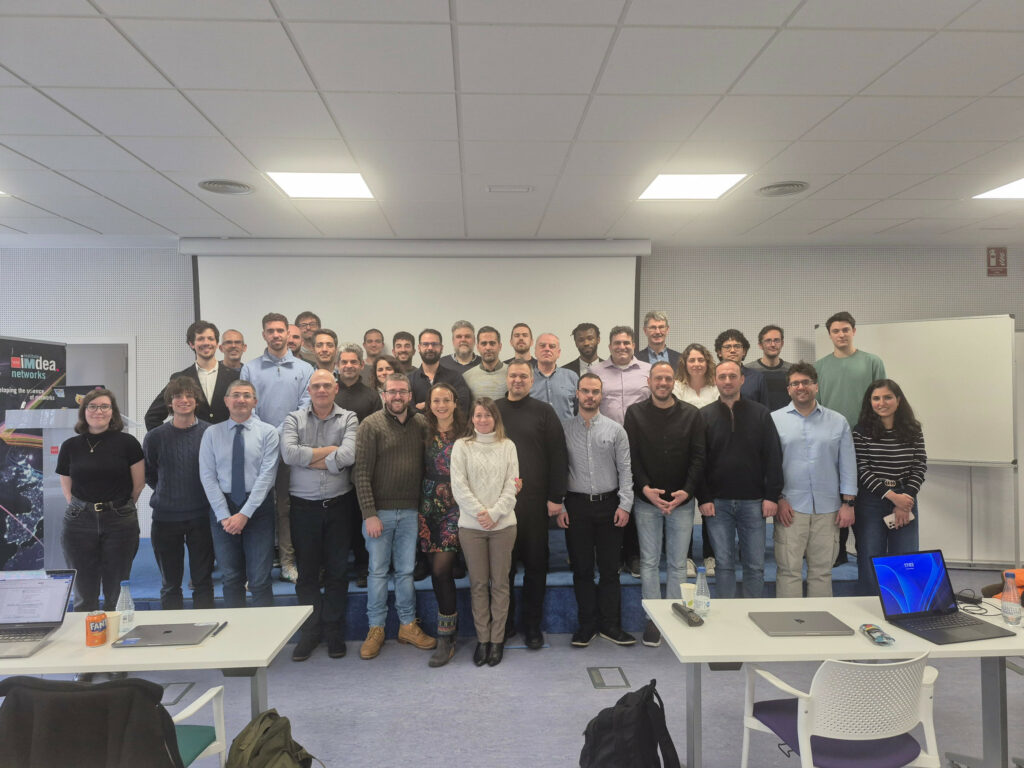
Cybernemo has been running for six months already. For this reason, partners involved in this EU project have gathered together in Madrid to celebrate their third general meeting.

The venue has focused on the strategies and challenges that the cibersecurity project needs to address in the core of its development.

TID for example presented the initial version of the Zero-Thrust Network Access (ZTNA) architecture, a more secure and efficient version of the mNCC (meta-Network Cluster Controller) network controller that we have been developing for the last two and a half years at NEMO PROJECT, another EU project.

We also had a very detailed session on Opensource and software licences given by Eclipse, a key aspect when dealing with code.

After two-day very interesting sessions all partners left to their hometowns having a clear vision of the next steps of the project.

Read More

Innovation at Universidad Politécnica de Madrid: The Role of GATV in Cybersecurity

The Universidad Politécnica de Madrid (UPM) is one of the most prestigious technical universities in Spain and Europe, renowned for its excellence in engineering, architecture, and technology-related disciplines. Since its establishment in 1971, UPM has grown into a leading institution in higher education, research, and innovation, attracting students from across the globe. The university offers a diverse range of undergraduate, graduate, and doctoral programs, providing high-quality education and fostering cutting-edge research opportunities.

UPM’s academic programs are meticulously designed to equip students with a solid blend of theoretical knowledge and practical skills, preparing them to become highly competent professionals and future industry leaders. The university’s distinguished faculty consists of esteemed scholars and experts who offer a rigorous academic experience with a strong focus on real-world applications.

Within UPM, the Visual Telecommunications Applications Group (GATV) is a renowned research group dedicated to advancing multimedia technologies across various applications, including virtual reality, immersive media, and multimedia communication. GATV has established a strong reputation for research excellence, contributing to numerous high-impact publications in leading international conferences and journals. The group actively participates in national and international research projects, focusing on areas such as 3D modeling and reconstruction, visual analytics, multimedia communication, and immersive media technologies.

Read More