Bringing trust to CyberNEMO: The Proof ofTransit component for ZTNA

In CyberNEMO, we’re building a Zero Trust Network Access (ZTNA) solution where every decision is backed by verifiable evidence. Beyond authenticating users and devices, we also need to ensure that the network paths packets take can be trusted. That’s where the Proof of Transit (PoT) component comes in.

What is the Proof of Transit (PoT)?

PoT, is a path verification mechanism. Its purpose is to guarantee that a packet has followed a predetermined route through specific nodes, providing security, traceability, and regulatory compliance.


This capability is essential in environments such as:

  • Service Function Chaining (SFC) with NFV

  • 5G and beyond network architectures

  • Critical infrastructure where packet order and integrity must be preserved

PoT ensures that packets not only arrive at their destination but also travel through the expected, authorized sequence of nodes.

How it Works?

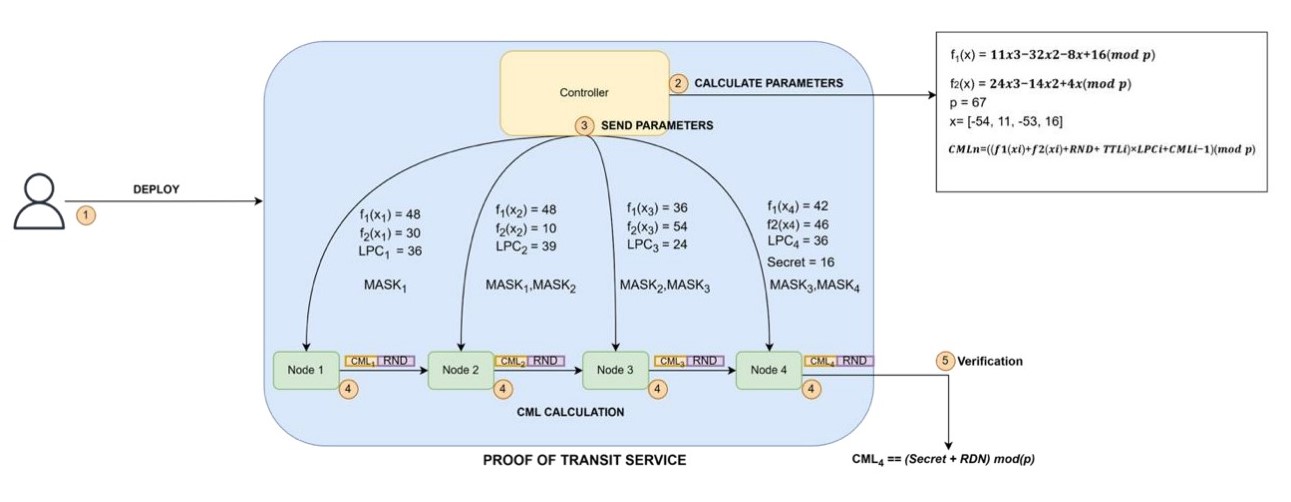
The IETF PoT draft defines two main approaches, both based on Shamir Secret Sharing (SSS):

1.Polynomial-based distribution:

  • A polynomial of degree n–1 (where n is the number of nodes) is generated.

  • Each node receives a point on the polynomial, used to verify its participation in the path.

2.Enhanced entropy with a public polynomial:

  • An additional polynomial (with no constant term) is introduced.

  • This is combined with a random value (RND) at the ingress node, creating a cumulative value (CML).

  • The value travels across all nodes, and the final node verifies it against the expected result, ensuring no tampering occurred.

Ordered Proof of Transit (OPoT)

PoT has naturally evolved into OPoT (Ordered Proof of Transit), which not only validates the nodes traversed but also guarantees the correct sequential order. This prevents reordering attacks and is particularly critical in Real-time, sequence- sensitive systems.


OPoT achieves this by using symmetric masks shared between contiguous nodes,
ensuring both authenticity and ordering of packets.

Why this matters for ZTNA

ZTNA is about “never trust, always verify.” Proof of Transit extends this principle to the network fabric itself. By integrating PoT and OPoT into CyberNEMO, we:

  • Ensure packets take only the approved, policy-compliant paths

  • Detect tampering, misrouting, or reordering of traffic

  • Provide strong traceability and auditability of packet flows

  • Meet compliance and regulatory requirements for sensitive environments

In other words, PoT brings verifiable trust to packet transit, strengthening the Zero Trust foundation of CyberNEMO.

Read More

Bringing trust to Cybernemo: The Notary component for ZTNA

In CyberNEMO, we’re building a Zero Trust Network Access (ZTNA) solution where every access decision is based on verifiable evidence. One of the core building blocks of this architecture is the Notary component, powered by our Transparent Notary Service (TNS).

What is the Transparent Notary Service (TNS)?

The TNS is essentially a digital notary for network evidence. Its job isn’t to decide whether a piece of evidence is good or bad, but to make sure that once evidence is registered, it stays immutable, timestamped, and cryptographically verifiable.

The TNS uses a lightweight append-only ledger. Each signed statement (such as a configuration attestation, event log, or policy proof) is stored in an immutable data structure like a Merkle tree. This allows anyone to verify inclusion and consistency without having to trust the notary itself.

How it works

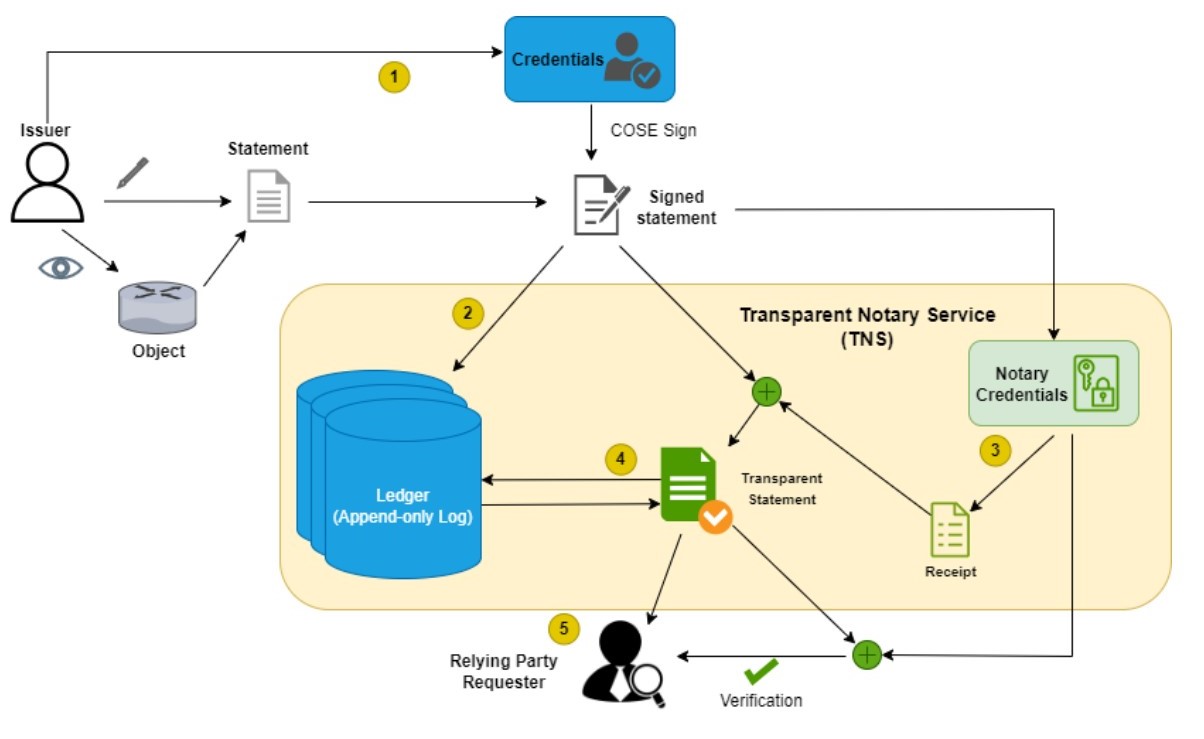
  1. Issuers sign statements using IETF’s COSE (CBOR Object Signing and Encryption) with algorithms like ECDSA or EdDSA.
  2. The Notary logs the statement, storing it in the append-only ledger.
  3. A receipt is generated that acts as proof of inclusion
  4. A Transparent Statement is generated including the original statement along with its receipt
  5. Relying parties can verify the statement’s authenticity and timestamp independently using the TNS public key

This design ensures that if someone tries to tamper with evidence or hide a log entry, it becomes immediately detectable.

Why this matters for ZTNA

ZTNA is all about “never trust, always verify.” But verification needs to be trustworthy too. By introducing a tamper-evident, verifiable notary into CyberNEMO, we:

  • Create strong audit trails for security events.

  • Improve accountability and compliance by preserving evidence.

  • Allow independent verification of access decisions without centralizing trust.

In other words, the Notary helps make our Zero Trust architecture provably trustworthy.

Read More

Zero Trust Principles

Zero Trust Principles in CyberNEMO: Building security by Design


Zero Trust has become one of the most important paradigms in modern cybersecurity. At its core, Zero Trust means no implicit trust; everything must be verified, every time. Every user, device, application, and service must prove its legitimacy before gaining access to resources, regardless of whether it’s inside or outside the corporate network.


In CyberNEMO, we’ve embraced these principles as the foundation of our ZTNA (Zero Trust Network Access) solution. The goal is to reduce the attack surface, prevent lateral movement, and enforce consistent security controls across all environments.


Zero Trust Principles


In CyberNEMO, we use the following Zero Trust principles as our architectural baseline:

  • Identity verification and strong authentication to ensure that only legitimate users and devices gain access.

  • Least privilege access enforcement, granting the minimum level of permissions necessary to perform specific tasks.

  • Micro-segmentation of networks and services to prevent unauthorized movement within the system.

  • Continuous monitoring and risk assessment to adapt dynamically to evolving threats and anomalies.

  • Data-centric security to protect sensitive information wherever it resides or travels.

How CyberNEMO implements them


Cybernemo’s ZTNA solution was built with these ideas from day one:

  • Micro-Segmentation with L2S-M: Built on the NEMO-developed Link-Layer Secure connectivity for Microservice platforms, L2S-M provides secure, dynamic segmentation across multi-cluster environments, overcoming the limitations of conventional network segmentation solutions.

  • Advanced Metrics & Telemetry: Using the ALTO protocol, combined with insights from BGP-LS, SDN controllers, and inventory systems, CyberNEMO ZTNA exposes abstract, real-time network metrics. These insights enable orchestration and deployment decisions that are aware of current network conditions and can react adaptively.

  • Secure and Verifiable Data Plane: Proof of Transit (PoT) is incorporated to validate packet flow integrity and sequence, providing traceability, regulatory compliance, and resilience against routing attacks or traffic manipulation.

  • Identity & Evidence Management: CyberNEMO adopts Distributed Ledger Technologies (DLTs) to ensure immutable, auditable records of access and configuration events.

    1) The Distributed Identity Manager (DID Manager) issues and validates decentralized, verifiable credentials, enabling federated identity management.

    2) The Transparent Notary Service (TNS) acts as a cryptographic notary for signed statements, preserving their integrity, timestamp, and origin authenticity. This allows any party to independently verify security events, configuration attestations, and policy decisions without having to trust the notary itself — enhancing accountability and auditability.

  • Policy Enforcement & Anomaly Detection: Network policies are enforced dynamically, while real-time anomaly detection mechanisms help mitigate threats as they emerge.

From Principles to Practice

Zero Trust is more than a security concept, it represents a fundamental shift in how networks are designed and operated. By embedding these principles directly into its architecture, CyberNEMO delivers a verifiable, adaptive, and resilient ZTNA solution for modern distributed environments.


With strong identity management, cryptographic evidence, micro-segmentation, and continuous monitoring, CyberNEMO provides not just access control but confidence in every access decision.


In short, CyberNEMO transforms Zero Trust from a guiding principle into a practical, measurable, and future-ready security architecture, enabling secure connectivity, prevent lateral movement, and build a trustworthy foundation for critical communications.

Read More

Cybersecurity in the Computing Continuum – The CyberNEMO Challenge

In today’s hyperconnected world, the Computing Continuum (CC)—spanning IoT devices, edge computing, and cloud infrastructure—presents both unprecedented opportunities and complex cybersecurity challenges. The CyberNEMO project, funded by the European Union’s Horizon Europe programme, is tackling this head-on with an end-to-end cybersecurity approach that integrates risk analysis, ethics and regulatory governance and compliance.

The recently published deliverable D1.1 outlines the threat and ethics assessment conducted across four critical sectors:

  • Smart energy and water infrastructures

  • Secure media content supply chains

  • Healthcare systems

  • Smart farming and logistics

Each of the four trials serves as a living lab to validate CyberNEMO’s technologies:

  • Smart meters and EV charging stations are protected against ransomware and data breaches using Zero Trust Network Architecture (ZTNA) and AI-based anomaly detection.

  • Media content is securely produced and distributed using microservices, encryption, and federated learning.

  • Hospitals defend against insider threats and phishing attacks while ensuring personal and confidential data sharing in compliance with GDPR and other relevant regulations.

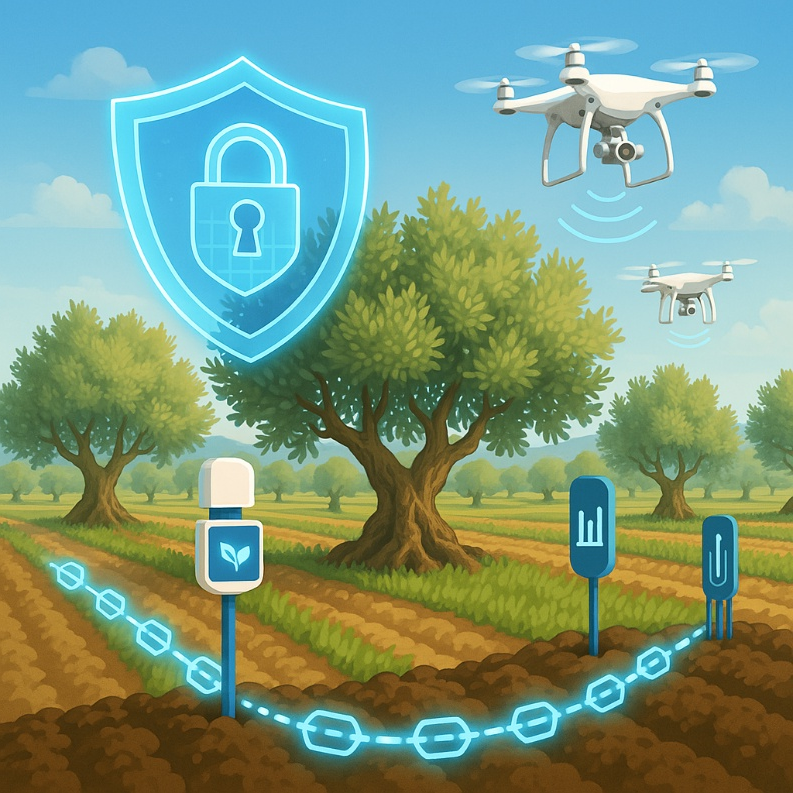
  • Smart farming systems use drones, IoT sensors, and blockchain to ensure traceability and cybersecurity in the olive oil supply chain

These trials demonstrate the scalability and adaptability of CyberNEMO across diverse sectors and regulatory environments

Using the MITRE ATT&CK framework, the project identified 44 unique threat types and over 100 functional and non-functional requirements, as well as 23 ethics and regulatory concerns and corresponding requirements. These threats and challenges range from credential theft and ransomware to data manipulation, ethics of AI and denial-of-service attacks.

At the heart of CyberNEMO is a meta-operating system (meta-OS) that orchestrates secure interactions across the CC. This system integrates:

  • Zero Trust Network Access (ZTNA): Every device, user, and service is treated as untrusted by default.

  • Federated Machine Learning (FML): Enables decentralized threat detection without compromising data privacy.

  • Secure Access Service Edge (SASE): Ensures secure connectivity across heterogeneous networks.

  • Digital Twins and Blockchain: Provide traceability, auditability, and resilience in supply chains 

This architecture is designed to be ethics-by-conception, modular, scalable, and interoperable, supporting a wide range of use cases and regulatory contexts

CyberNEMO is not just about technology, it’s about building a secure, ethical, and resilient digital future.

You can explore the official project page on the EU CORDIS portal or follow updates from the coordinating partner Synelixis 

Read More

CyberNEMO Promotion through AIOTI Standardization Reports

CyberNEMO has commenced the interaction with AIOTI (Alliance for AI, IoT and Edge Continuum Innovation). The project has provided introductory information, including planned and developed use cases, to be featured in AIOTI’s standardization reports. These reports are circulated within the AIOTI community, the European Commission, and key Standards Developing Organizations (SDOs) such as ETSI, ISO/IEC, ITU-T, 3GPP, and IEEE.

CyberNEMO’s contributions offer insights into the landscape of research challenges and ongoing standardization efforts, at the intersection of AI, IoT, and edge computing. AIOTI’s mission is to lead and bridge innovation in these domains, supporting European deployment and fostering global cooperation, while safeguarding European values. More information about AIOTI and its standardization resources is available at: https://aioti.eu/resources-standardisation/

The initial positioning information refers to key research challenges, such as:

  • Zero Trust and Identity Management in dynamic IoT, edge and cloud environments
  • Runtime Threat Detection and Self-Healing Architectures
  • Secure and Privacy-Preserving AI at the Edge
  • Tailored Security for Constrained IoT Devices
  • Secure AI/ML Model Lifecycle at the Edge

In addition, CyberNEMO has outlined its expected activities in monitoring and collaborating with standardization bodies and initiatives, especially in the fields of AI-driven security, trusted edge computing, resilience, and cyber threat intelligence (CTI) sharing. This engagement will be supported by the active involvement of project partners participating in these organizations.

By: SYN

Read More

Safeguarding Critical Infrastructures: CyberNEMO’s Smart Energy & Water Trial

As digital technologies become more deeply embedded in our cities, the need to protect critical infrastructures, such as electricity grids and water systems, from cyber threats is more urgent than ever. In the CyberNEMO project, Trial 2, coordinated by ASM Terni, addresses this challenge through a real-world deployment in a multi-utility environment.


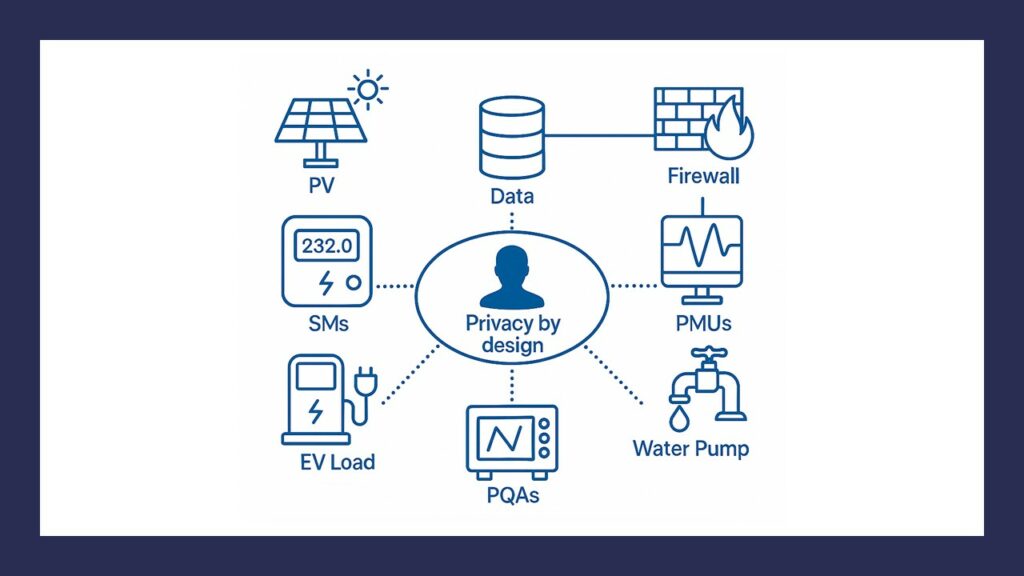
This trial evaluates how advanced cybersecurity solutions can protect smart energy and water systems from coordinated cyberattacks. From securing smart meters and EV charging infrastructure to protecting photovoltaic (PV) plants, power quality analyzers, and water pumps, Trial 2 replicates realistic threat scenarios with critical implications.

What makes this trial particularly relevant is its focus on:
• Cross-domain impact assessment, exploring how cyberattacks on the electricity network could disrupt water systems.
• Real-time monitoring, using data from PMUs, PQAs, and firewall logs to detect anomalies and simulate coordinated threats.
• Privacy-by-design, ensuring sensitive data collected via smart meters or firewalls remains anonymized and protected under GDPR.

All collected datasets are structured, validated, and governed under a strict data management framework, supporting both technical research and ethical responsibility. ASM’s infrastructure enables a practical and scalable setup, serving as a living testbed for advancing Europe’s digital resilience.

By ASM

Read More