Every day, critical infrastructures generate enormous amounts of cyber data, from hospitals and smart energy networks to drones, media platforms, and logistics systems. This information is essential for developing better cybersecurity tools, but it also raises an important question:
How can we share valuable cyber data without exposing people’s privacy?
At CyberNEMO, the answer is anonymisation.
Why Technical Data Isn’t as Anonymous as It Looks
Many people assume that if a dataset doesn’t contain names, it’s already anonymous. Unfortunately, that’s not always true.
Technical information such as IP addresses, timestamps, GPS locations, or device identifiers can often be linked back to individuals, organisations, or specific systems. Even cybersecurity logs can reveal working patterns, locations, or sensitive infrastructure details.
That’s why every dataset collected across CyberNEMO’s pilots is treated as potentially identifying, even when no personal names are present.
Turning Sensitive Data into Safe, Reusable Datasets
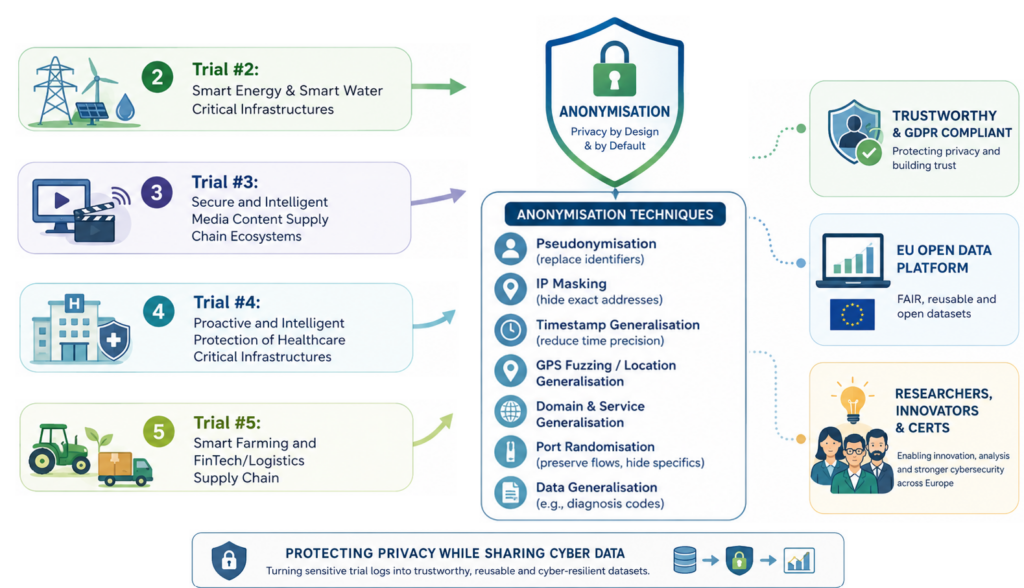
CyberNEMO applies several anonymisation techniques that protect privacy while preserving the information researchers need.
Some examples include:
- Replacing real identities with anonymous labels so users and devices can still be tracked within a dataset without revealing who they are.
- Masking IP addresses to hide the exact location of computers while keeping network traffic patterns intact.
- Generalising timestamps, for example recording activity by hour instead of by the exact second.
- Reducing GPS precision so drone flights and smart infrastructure can be analysed without revealing precise locations.
- Hiding sensitive server names and service details while maintaining realistic communication patterns.
- Generalising medical information so healthcare datasets remain useful for cybersecurity research without exposing patient information.
The goal is simple: preserve the value of the data while removing the details that could identify people or critical systems.
Why This Matters
Effective anonymisation allows CyberNEMO to balance two equally important goals:
- Protect citizens’ privacy and comply with GDPR.
- Enable researchers, innovators, and cybersecurity experts to work with realistic datasets.
This supports the European vision of privacy by design, helping organisations collaborate without exposing sensitive information.
From Protected Data to Shared Knowledge
Once anonymised and validated, CyberNEMO datasets can be securely shared across the consortium to support the development and validation of cybersecurity technologies.
Following the FAIR principles (Findable, Accessible, Interoperable and Reusable), selected anonymised datasets are planned to be published through trusted open-data repositories such as Zenodo, subject to consortium approval and the necessary legal and ethical clearances.
Publishing datasets through Zenodo provides long-term preservation, persistent Digital Object Identifiers (DOIs), and enables researchers worldwide to discover, cite, and reuse CyberNEMO research outputs.
This approach allows researchers to evaluate new cybersecurity techniques using realistic operational data while fully respecting privacy and data protection requirements.
The benefits extend well beyond the CyberNEMO project:
- Researchers can develop, benchmark, and validate new cybersecurity detection algorithms using realistic datasets.
- SMEs and technology providers can accelerate the development of innovative cybersecurity products and services.
- Public authorities and critical infrastructure operators can promote secure, trustworthy, and responsible data sharing across Europe.
- The wider research community benefits from reusable datasets that support reproducible research and future innovation in cybersecurity and critical infrastructure protection.
Privacy Enables Innovation
Anonymisation is often viewed as a compliance requirement, but in CyberNEMO it is much more than that.
It is the foundation that transforms sensitive operational data into trusted, reusable knowledge. Instead of keeping valuable cybersecurity information locked away, anonymisation allows Europe to share what matters while protecting the people behind the data.
That’s how CyberNEMO helps build a stronger, more collaborative, and more privacy-conscious cybersecurity ecosystem.