

Europe’s digital infrastructure is being rewired. Data processing is migrating away from centralised hyperscale data centres toward the logical and physical periphery of networks — the “Edge.” This shift, often described as the evolution toward a Cloud-Edge Continuum, is no longer a future scenario: it is the present reality of Industry 4.0, the Internet of Things, and autonomous systems that simply cannot tolerate the latency of a round-trip to the cloud.
The numbers confirm the scale of what is happening. The European edge computing market is projected to grow from approximately €4.5 billion in 2024 to over €56.6 billion by 2033, driven by a Compound Annual Growth Rate exceeding 31%.To put that in perspective, this is one of the fastest-growing technology segments on the continent, outpacing most of the broader digital economy.
Yet behind these extraordinary growth figures, a structural problem is forming — one that CyberNEMO was built to address. While infrastructure investment accelerates, cybersecurity spending is not keeping pace. Security budgets are actually forecast to drop to 10.9% of overall IT spend in 2025 (Figure 1), even as the threat landscape intensifies.
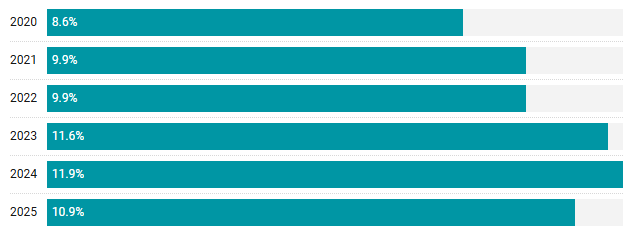
Figure 1. The average security budget as a percentage of IT spending had been growing steadily until this year. Chart: CFO.com Source: IANS Research and Artico Search
ENISA’s own reporting confirms the picture: EU organisations spent an average of €1.5 million on cybersecurity in 2024, representing roughly 9% of their total IT allocations — and even that figure is under pressure from ongoing budget cuts across the continent.The result is a widening “vulnerability deficit”: European enterprises are deploying more distributed, more exposed infrastructure with proportionally fewer resources dedicated to defending it.
This is not a marginal risk. The broader European cybersecurity market — covering cloud, endpoint, and network security — is valued at approximately €53 billion in 2024 and is expected to reach €100 billion by 2030 at a CAGR of roughly 11.2%.The gap between edge deployment speed and security investment speed is, in other words, a gap between two very large numbers — and it is growing in the wrong direction.
There is also a currency dimension that often goes unnoticed. A significant share of edge hardware and software licences is priced in US dollars, sourced from American hyperscalers (AWS, Microsoft, Google). Euro-denominated European firms are therefore exposed to exchange rate volatility on top of their infrastructure costs. This is one of the quiet drivers behind the “Sovereign Cloud” movement, pushing enterprises toward local providers like Deutsche Telekom or Orange Business whose cost bases sit in euros — and whose legal obligations sit within EU jurisdiction.
The edge is where Europe’s industrial future will be computed. CyberNEMO’s mission is to ensure it is also where it will be secured.