Kubernetes revolutionised the deployment of cloud-native applications by making workloads portable, scalable, and easy to orchestrate. However, while Kubernetes excels at managing applications, its networking model introduces an important challenge for network services: a lack of flexibility in its networking model.
Most Kubernetes deployments rely on a flat network approach where every pod can potentially communicate with every other pod inside the cluster. Although Network Policies can restrict some traffic flows, workloads still fundamentally share the same networking space. For traditional microservice applications, which are usually application-layer oriented, this behaviour may be acceptable, but for network functions, multi-tenant platforms, or security-sensitive services, this approach quickly becomes limiting. This is where micro-segmentation becomes critical.
Micro-segmentation is the practice of dividing an infrastructure into isolated virtual network segments, where workloads only communicate with the components explicitly allowed to them. Instead of treating the cluster as a single trusted environment, micro-segmentation applies the principles of least privilege directly to network connectivity.
The benefit of applying micro-segmentation over K8s platforms can be substantial. First, micro-segmentation improves security by reducing lateral movement. If one workload becomes compromised, attackers cannot freely traverse the infrastructure to reach other services. Each segment behaves as an isolated environment with controlled entry and exit points.
Second, it enables the deployment of advanced network services inside Kubernetes. Functions such as firewalls, routers, proxies, or content delivery components often require separated Layer 2 or Layer 3 domains to operate correctly. In a flat network, these services lose much of their networking context because every workload remains directly reachable.
Third, micro-segmentation simplifies multi-tenant deployments. Different applications, customers, or services can coexist within the same Kubernetes infrastructure while remaining logically isolated from one another. This becomes increasingly important in edge computing, telecom platforms, and distributed cloud environments.
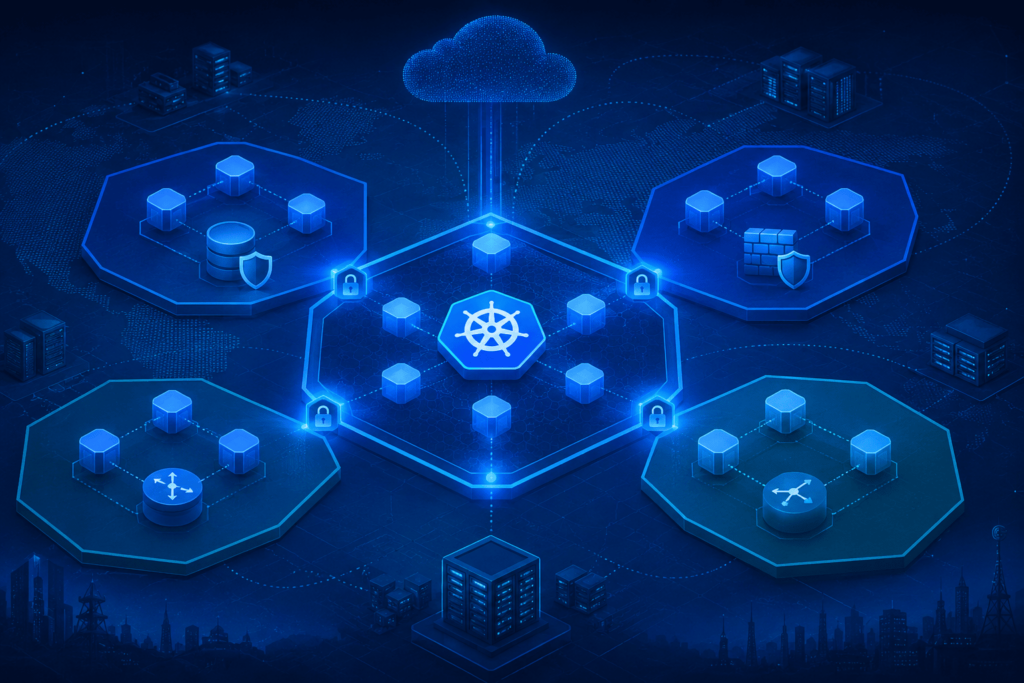
At the infrastructure level, achieving true micro-segmentation requires more than simple traffic filtering. It requires programmable virtual networking capable of creating isolated communication domains between workloads, independently of where they are physically deployed. This becomes even more relevant in distributed cloud-edge environments, where services may span multiple Kubernetes clusters and heterogeneous infrastructures.
To address these challenges, the CyberNEMO Zero Trust Network Access (ZTNA) framework extends the capabilities of the NEMO meta Network Cluster Controller (mNCC) to provide secure micro-segmentation mechanisms for both intra-cluster and inter-cluster communications. By enabling isolated virtual networking domains across cloud-native infrastructures, CyberNEMO introduces a flexible networking foundation for advanced network services, secure workload isolation, and distributed edge deployments. In next posts, we will explore in more detail the technology behind this functionality:
L2S-M.Why Micro-Segmentation Matters in Kubernetes
Kubernetes revolutionised the deployment of cloud-native applications by making workloads portable, scalable, and easy to orchestrate. However, while Kubernetes excels at managing applications, its networking model introduces an important challenge for network services: a lack of flexibility in its networking model.
Most Kubernetes deployments rely on a flat network approach where every pod can potentially communicate with every other pod inside the cluster. Although Network Policies can restrict some traffic flows, workloads still fundamentally share the same networking space. For traditional microservice applications, which are usually application-layer oriented, this behaviour may be acceptable, but for network functions, multi-tenant platforms, or security-sensitive services, this approach quickly becomes limiting. This is where micro-segmentation becomes critical.
Micro-segmentation is the practice of dividing an infrastructure into isolated virtual network segments, where workloads only communicate with the components explicitly allowed to them. Instead of treating the cluster as a single trusted environment, micro-segmentation applies the principles of least privilege directly to network connectivity.
The benefit of applying micro-segmentation over K8s platforms can be substantial. First, micro-segmentation improves security by reducing lateral movement. If one workload becomes compromised, attackers cannot freely traverse the infrastructure to reach other services. Each segment behaves as an isolated environment with controlled entry and exit points.
Second, it enables the deployment of advanced network services inside Kubernetes. Functions such as firewalls, routers, proxies, or content delivery components often require separated Layer 2 or Layer 3 domains to operate correctly. In a flat network, these services lose much of their networking context because every workload remains directly reachable.
Third, micro-segmentation simplifies multi-tenant deployments. Different applications, customers, or services can coexist within the same Kubernetes infrastructure while remaining logically isolated from one another. This becomes increasingly important in edge computing, telecom platforms, and distributed cloud environments.
At the infrastructure level, achieving true micro-segmentation requires more than simple traffic filtering. It requires programmable virtual networking capable of creating isolated communication domains between workloads, independently of where they are physically deployed. This becomes even more relevant in distributed cloud-edge environments, where services may span multiple Kubernetes clusters and heterogeneous infrastructures.
To address these challenges, the CyberNEMO Zero Trust Network Access (ZTNA) framework extends the capabilities of the NEMO meta Network Cluster Controller (mNCC) to provide secure micro-segmentation mechanisms for both intra-cluster and inter-cluster communications. By enabling isolated virtual networking domains across cloud-native infrastructures, CyberNEMO introduces a flexible networking foundation for advanced network services, secure workload isolation, and distributed edge deployments. In next posts, we will explore in more detail the technology behind this functionality: L2S-M.