
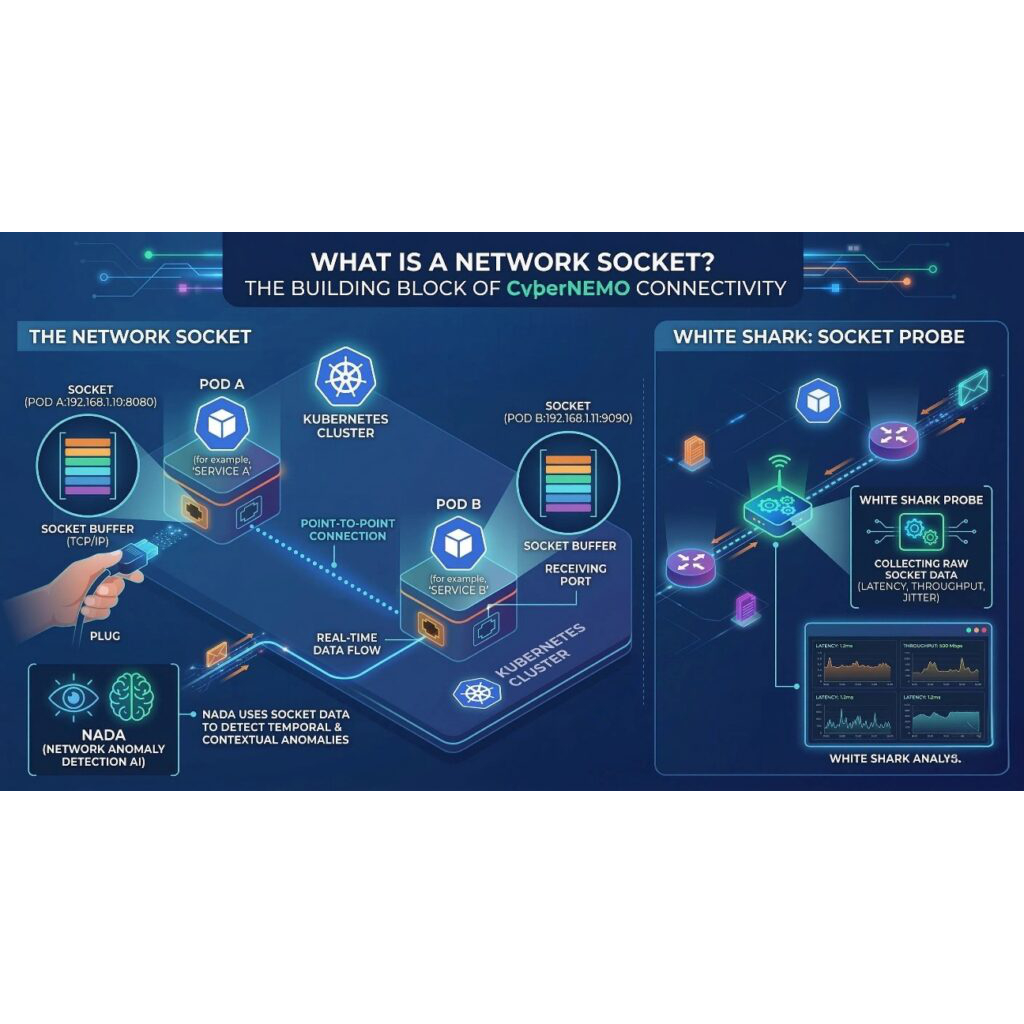
In the complex architecture of the CyberNEMO meta-Operating System, ensuring secure and reliable communication across the computing continuum is paramount. While high-level security frameworks like Zero Trust Network Access (ZTNA) provide the overarching strategy, the actual heavy lifting of data exchange happens at a much more fundamental level: the network socket.
A network socket is essentially an internal endpoint for sending or receiving data at a single node in a computer network. Think of it as a virtual “plug” that allows two different processes—whether they are on the same machine or across the world—to talk to each other. In a Kubernetes (K8s) environment, which serves as the foundation for CyberNEMO’s deployment, sockets are the critical bridges between containerized microservices. They enable the point-to-point communication necessary for workloads to function as a unified system.
Why Sockets Matter for Network Measurement
Within the WP2 (Work Package 2), the focus is on “Cybersecurity and Privacy by Design”. To achieve this, we cannot rely on surface-level metrics. We need to measure real communication at the socket level. This is where components like White Shark come into play.
Originally developed for the NEMO project, White Shark is a specialized network probe designed to collect and retrieve high-fidelity network data. By tapping into socket communication, White Shark can measure point-to-point metrics—such as latency and throughput—directly between two endpoints. This provides a level of precision that traditional network monitors often miss, as it captures the actual data flow as seen by the applications themselves, rather than just the underlying infrastructure.
From Raw Data to Intelligence: The Role of NADA
Capturing socket-level data is only half the battle; the next step is making sense of it. In CyberNEMO, this data is fed into the Network Anomaly Detection AI (NADA). NADA’s purpose is to identify temporal and contextual anomalies—suspicious patterns in the network traffic that could indicate a security breach.